

Planning a company Christmas party means finding an event format that suits your team, guest numbers, budget and company culture, while still feeling like a genuine end-of-year celebration.
The best corporate Christmas party ideas for Australian workplaces include gala dinners, rooftop functions, river cruises, long lunches, cocktail parties, summer festivals, family days, game-show nights, live band parties and smaller team experiences.
The right choice depends on what you want guests to do once they arrive. Do you want people circulating and talking, sitting down for a polished dinner, taking part in an activity or ending the night on the dance floor?
That decision should come before choosing a theme or filling the programme with entertainment.
A rooftop party, for example, can be casual or formal. A gala dinner can finish with dancing or remain seated. A long lunch can include awards, acoustic music or a roving performer.
Start with the experience you want guests to have, then choose the venue, food, entertainment and timing that will support it.
Corporate Christmas Party Ideas for Polished Evening Events
1. Gala Dinner
Best Suited To: Medium to large companies, client-inclusive functions and formal end-of-year celebrations
Atmosphere: Polished, celebratory and structured
A gala dinner suits companies that want the Christmas function to feel like a significant occasion. Guests arrive for pre-dinner drinks before the programme moves through dinner, formal thanks, entertainment and, where appropriate, dancing.
This format can accommodate partners, clients, board members and interstate employees while giving the evening a clear beginning, middle and end. The venue needs more than attractive décor, so check sightlines, staging, sound, production space and the relationship between the dining area and dance floor.
A beautiful ballroom won’t help if a third of the guests can’t see the stage or the band is wedged behind a row of tables.
2. Christmas Awards Night
Best Suited To: Companies that recognise staff achievements, service milestones or annual performance
Atmosphere: Appreciative, energetic and company-focused
Combining an annual awards night with the Christmas party can make practical sense. The venue, catering, production and guest list are already in place, while the awards give the evening a stronger purpose than food and drinks alone.
The main risk is allowing the ceremony to consume the function. A long run of similar awards can lose the room quickly, so combine overlapping categories, remove filler awards and give every presenter a firm time limit. A professional event MC can introduce presenters, keep winners moving and shorten transitions when the schedule begins to slip.
Once the final award has been presented, deliberately change the mood. A feature performance, lighting change or recognisable opening song can signal that the formal programme has finished and the party has begun.
3. Cocktail Party with Roving Entertainment
Best Suited To: Mixed departments, networking-heavy companies and medium to large guest lists
Atmosphere: Social, flexible and conversational
A cocktail party gives guests the freedom to circulate instead of spending the evening seated beside the same people. It works particularly well when colleagues come from different departments, offices or locations, although without enough structure guests can still remain in the same small groups all night.
Roving entertainment gives people an easy reason to interact. A magician, caricaturist or interactive performer can create a shared moment between guests who might otherwise struggle to begin a conversation, and because the entertainment moves through the room, nobody needs to stop and gather in front of a stage.
Provide enough seating and consistent food service, particularly for guests who can’t comfortably stand for several hours.
4. Private Dining Experience
Best Suited To: Smaller businesses, leadership teams, client groups and teams of approximately 10 to 40
Atmosphere: Personal, refined and conversation-led
A private dining experience suits a team that values good food and conversation more than large-scale production. The event might take place in a restaurant dining room, winery, hotel suite or private venue, with a shared or degustation menu providing enough theatre without requiring a stage, theme or elaborate AV setup.
Entertainment should match the scale of the room. A close-up magician during pre-dinner drinks, an acoustic duo or a short comedy set may work better than a full band, particularly when conversation is meant to remain a major part of the evening.
The main advantage is control. Guests can hear one another, service is contained and the organiser isn’t trying to create atmosphere in a ballroom built for three times the number attending.
Summer and Outdoor Corporate Christmas Party Ideas
5. Rooftop Christmas Party
Best Suited To: City-based teams, client functions and early-evening cocktail events
Atmosphere: Contemporary, relaxed and lively
A rooftop Christmas party provides much of its own atmosphere. As daylight fades and the city lights come on, the function can move naturally from welcome drinks into a livelier evening.
The practical details determine whether the format works. Ask about wind exposure, noise restrictions, shade, lift access, supplier loading and wet-weather capacity. A rooftop that holds 180 people outdoors may have an indoor alternative suitable for only 70.
Also check whether noise limits allow amplified music. Discovering that the DJ or band must finish at 9.30 pm can substantially change the event you thought you were booking.
For local venue and activity inspiration, see our guide to Christmas party ideas in Brisbane.
6. River or Harbour Cruise
Best Suited To: Teams wanting a self-contained venue and a clear sense of movement
Atmosphere: Scenic, social and removed from the everyday
A private river or harbour cruise changes the atmosphere before the entertainment begins. Guests board together, the scenery moves throughout the event and there’s no need to transfer between drinks, dinner and entertainment venues.
The fixed departure time is both an advantage and a limitation. It gives the evening a clear start, but late guests can’t simply arrive 20 minutes later, so invitations need to make boarding times and locations unmistakable.
Check accessibility, motion sensitivity, outdoor cover, sound restrictions and usable floor space. A vessel’s maximum capacity doesn’t necessarily show how many guests can dine, move and dance comfortably once furniture, catering and entertainment equipment are onboard.
An acoustic duo, compact DJ setup or roving magician often suits a cruise better than a large production requiring substantial stage space.
7. Summer Festival
Best Suited To: Large companies, mixed workforces and events where guests want different ways to participate
Atmosphere: Informal, energetic and spread across several zones
A summer festival gives a large workforce several ways to enjoy the same event. One area might feature live music, while others provide food, conversation, casual games and interactive entertainment.
This format works well for guest lists containing different age groups, departments and social preferences because people can choose the level of activity that feels comfortable.
The site still needs a clear layout. Consider power, sound spill, toilets, shade, seating, food queues, accessibility and movement between zones. If the bar, band and main food area are too widely separated, the function can feel empty even with several hundred people attending.
The event should feel relaxed to guests, but the planning behind it needs to be precise.
8. Corporate Family Day or Christmas Carnival
Best Suited To: Companies inviting partners and children, larger workforces and daytime celebrations
Atmosphere: Inclusive, active and family-friendly
A corporate family day or Christmas carnival lets employees include the people who supported them throughout the year.
The strongest family events aren’t simply children’s parties with a staff barbecue attached. They provide different activities for adults, teenagers and younger children, along with shaded seating, good food and quieter places to talk.
Roving performers can move between activity areas rather than drawing every guest towards one stage. Stilt walkers, magicians, bubble artists and circus performers can add activity throughout the site, while a central MC manages announcements, competitions and brief formalities.
Plan the event so parents don’t spend the whole function supervising an activity queue. Professional operators, clear age guidance and well-positioned seating make the day easier for everyone.
9. Outdoor Garden Party
Best Suited To: Daytime or early-evening functions, professional teams and relaxed client events
Atmosphere: Calm, conversational and visually appealing
An outdoor garden party creates a softer atmosphere than a ballroom, nightclub or warehouse venue. Think shaded tables, cold drinks, comfortable furniture and entertainment that supports conversation.
An acoustic duo can establish the mood as guests arrive, while lawn games provide an optional activity between food service and formalities.
Avoid spreading the function across too much space. When the bar, seating, food and entertainment are far apart, the crowd loses energy.
The wet-weather alternative must fit the real guest count. A veranda built for 40 people isn’t a practical backup for an outdoor function of 150.
10. Beach-Club-Style Event
Best Suited To: Relaxed companies, resort venues and teams wanting a contemporary summer atmosphere
Atmosphere: Casual, stylish and music-led
A beach-club-style Christmas party doesn’t require an actual beach. A resort, poolside venue, riverside terrace or open-air function space can create the same atmosphere through furniture, lighting, music and summer-friendly food.
Keep the styling contemporary. There’s no need for grass skirts, plastic leis or a generic tropical costume requirement. A restrained coastal look, shaded lounges and good music will produce a more polished result.
Dress requirements should remain optional and workplace-appropriate. Guests should be able to attend comfortably without wearing swimwear or a themed costume.
11. Food-Truck Festival
Best Suited To: Informal workplaces, outdoor venues, industrial spaces and groups with varied food preferences
Atmosphere: Casual, social and flexible
A food-truck festival can turn catering into part of the event rather than something happening behind closed doors. It works well in courtyards, breweries, warehouse precincts and private grounds with suitable vehicle access, while several cuisines give guests more choice than a fixed menu.
The main risk is queuing. Ask each operator how many meals they can realistically serve per hour, stagger opening times where appropriate and circulate smaller food options while guests wait.
The site still needs a central social area. Position the bar, seating and entertainment so the trucks frame the party instead of creating several disconnected queues around a car park.
Entertainment-Led Work Christmas Party Ideas
12. Live Band Dance Party
Best Suited To: Companies that want dancing to become a major part of the evening
Atmosphere: Energetic, performance-led and celebratory
A live band dance party gives the evening a performance element that a playlist can’t reproduce. Guests can see the musicians responding to the room and feel the energy build across each set.
The venue must support the performance, so check stage space, sound limits, supplier access, power, production requirements and the distance between the band and dance floor. A band positioned on the opposite side of the room will struggle to connect with guests.
Choose live bands for corporate events according to the crowd and desired atmosphere, not only the organiser’s personal taste. For a mixed-age corporate audience, a versatile repertoire covering several decades usually gives more guests a reason to dance.
13. DJ-Led After-Work Party
Best Suited To: Mixed-age audiences, flexible music requirements and venues with limited stage space
Atmosphere: Relaxed at first, then progressively more energetic
A DJ-led after-work party can begin with relaxed drinks and gradually build into a proper dance floor. Music can stay low during arrivals and food service, lift after speeches and change again once guests are ready to dance.
A good corporate DJ should read that progression rather than opening with a nightclub set while guests are still finding the bar. Give them a clear brief covering:
- Expected age range
- Company culture
- Preferred music styles
- Key songs
- Music to avoid
- Speech and award timings
- Venue noise restrictions
For extra energy, a saxophonist, percussionist or vocalist can perform alongside the DJ without requiring the stage space and production footprint of a full band.
14. Interactive Trivia or Game-Show Night
Best Suited To: Teams that enjoy structured participation without wanting a highly physical activity
Atmosphere: Competitive, social and fast-moving
A professionally hosted trivia or game-show night gives guests something shared to do without requiring them to dance or spend the entire evening making small talk. The format can combine trivia, visual rounds, music and short audience challenges.
Mix departments across teams rather than allowing everyone to remain in their usual work groups. A few tailored company questions can make the game feel personal, but avoid building the whole event around internal jokes that exclude new employees or partners.
A focused 60-minute programme will usually create more energy than several hours of increasingly difficult trivia. Schedule food before, after or between rounds, as guests won’t concentrate on complex questions while a main course is being placed in front of them.
15. Casino-Style Evening
Best Suited To: Cocktail functions and guests who prefer optional, self-paced interaction
Atmosphere: Sociable, sophisticated and lightly competitive
A casino-style evening gives guests an activity they can join and leave at their own pace. Blackjack, roulette and poker-style tables can be positioned around a cocktail venue, allowing people to play, watch or continue talking.
Use play chips rather than real-money wagering, with prizes based on final points, raffle entries or a light-hearted tournament. Provide enough dealers and space around each table to prevent crowding.
Explain the rules clearly so first-time players don’t feel excluded. A short MC-led presentation can bring the room together for prizes before the final entertainment begins.
16. Retro or Disco Party
Best Suited To: Dance-focused events and companies comfortable with a visible theme
Atmosphere: Colourful, familiar and energetic
A retro or disco party gives guests an immediate musical and visual reference point. Seventies disco, eighties pop and nineties dance can each provide a clear creative direction, but the strongest result feels curated rather than assembled from unrelated props.
Costumes should be encouraged rather than compulsory. Some employees will happily arrive in flares or sequins, while others will prefer standard cocktail attire. Both groups should still feel as though they belong at the event.
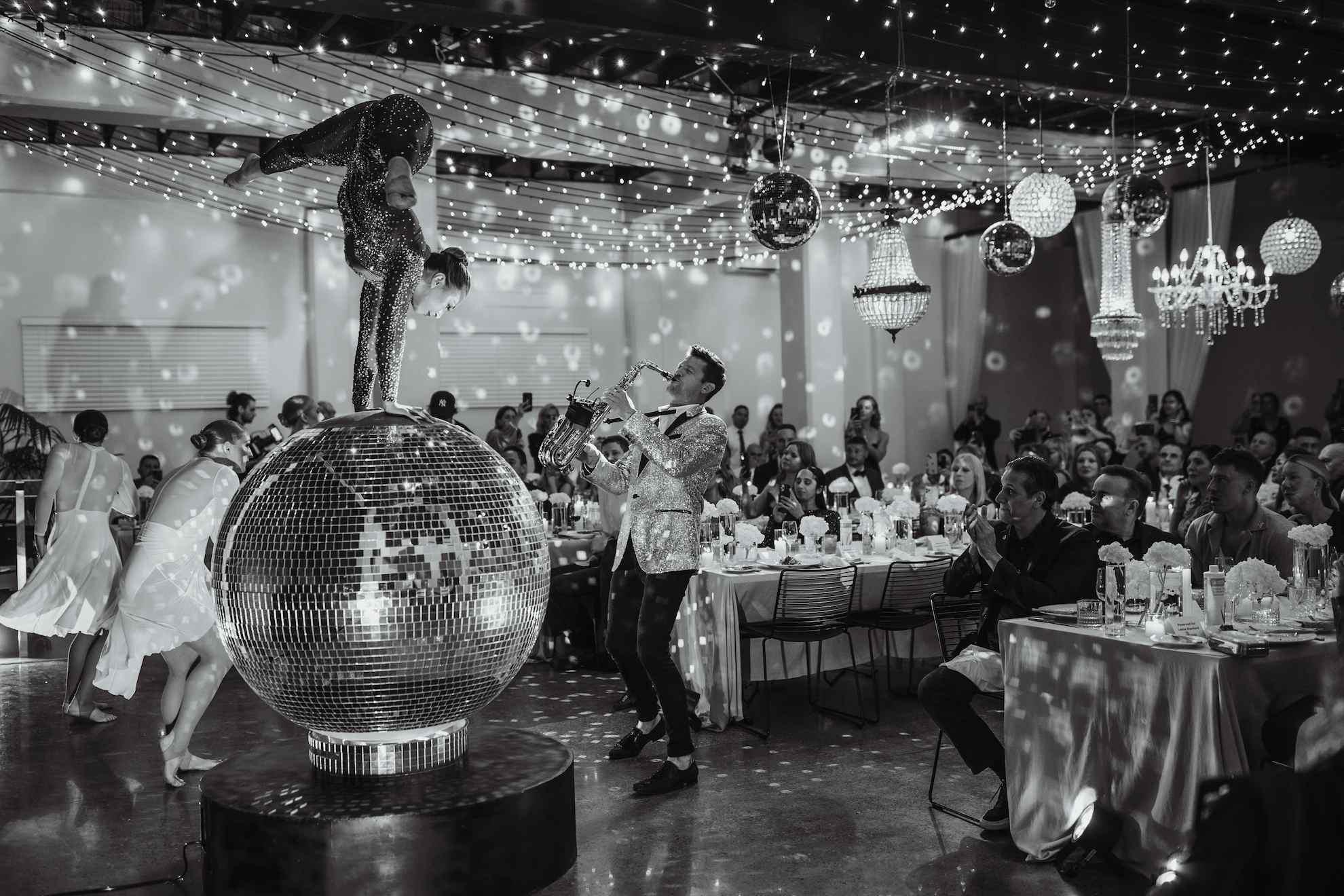
Entertainment carries the theme more effectively than décor alone. Professional dancers, a themed band or the right DJ can establish the atmosphere within minutes.
17. Comedy Night
Best Suited To: Seated dinners, theatre-style venues and teams that enjoy a shared performance
Atmosphere: Relaxed, focused and laughter-led
A corporate comedy night can be a strong alternative for a team that’s unlikely to fill a dance floor. The performer needs a proper brief covering the audience, company culture, event purpose and content boundaries.
A professional corporate comedian should engage a mixed workplace crowd without humiliating employees or turning the evening into an uncontrolled staff roast.
Sightlines and sound also matter. Comedy becomes difficult when half the audience can’t see the performer or bar service continues noisily throughout the set. A 20- to 40-minute performance after dinner is usually enough to create a clear feature without stalling the evening.
18. Christmas Party with a Feature Act
Best Suited To: Large functions, gala dinners, milestone years and companies wanting one clear programme highlight
Atmosphere: Dramatic, focused and production-led
A feature act is designed to make the room stop and watch. Options might include an aerial performance, LED dance production, drumming act, illusionist, circus performance or custom show connected with the company’s theme.
The act should have a clear role in the run sheet. It might open the room, introduce the awards, follow the managing director’s speech or move the event from dinner into dancing.
Don’t place a feature act randomly because a gap has appeared in the schedule. Much of its impact comes from timing and presentation.
Confirm ceiling height, rigging, stage access, lighting and rehearsal requirements before committing to both the venue and performer. Technical limitations discovered late can restrict the acts available or require costly production changes.
Relaxed, Small-Team and Purpose-Led Ideas
19. Long Lunch
Best Suited To: Professional teams, smaller businesses and guests who prefer conversation to a late finish
Atmosphere: Generous, relaxed and unhurried
A long lunch is simple, but it doesn’t have to feel like an ordinary Friday meal. A private room, thoughtful menu and one well-chosen entertainment element can give the occasion shape, whether that’s an acoustic performer during arrival, a roving magician between courses or a brief end-of-year presentation.
Daytime timing can suit employees with caring responsibilities or longer journeys home, while also avoiding another Friday evening during an already crowded period.
Keep formalities concise. A long lunch should feel generous and unhurried, not like an awards dinner compressed into the afternoon.
20. Small-Team Experience or Destination Celebration
Best Suited To: Teams of approximately 8 to 40, leadership groups and businesses wanting a personal reward
Atmosphere: Shared, tailored and experience-led
A small-team experience or destination celebration can feel more personal than hiring a function room, particularly when the group is small enough to share one activity together.
Options might include:
- Private cooking class
- Cruise
- Escape room
- Creative workshop
- Winery lunch
- Resort stay
- Theatre night
- Destination dinner
- Private karaoke room
Choose an activity that doesn’t depend on everyone having the same physical ability, confidence or enthusiasm. Guests should be able to participate at different levels without one person’s discomfort becoming part of the entertainment.
For destination events, consider travel time, accessibility, accommodation and employees with family or caring responsibilities. A reward should feel like a reward, not an obligation that occupies an entire weekend.
21. Charity or Volunteering Celebration
Best Suited To: Values-led organisations and teams wanting an alternative to a traditional party
Atmosphere: Purposeful, practical and community-focused
A charity or volunteering celebration can give the end-of-year function a practical community focus. That might involve fundraising, assembling useful items, supporting a food programme, volunteering or providing skilled assistance.
Let the charity help define what is genuinely useful, rather than designing an activity mainly for corporate photographs. Participation should also remain appropriate and voluntary, as employees may have personal reasons for not engaging with a particular organisation or cause.
The social part of the event can follow the volunteering component. A lunch, drinks or light entertainment gives the team time to relax together once the activity is complete.

How to Choose the Right Corporate Christmas Party
The right format should match the people attending, the purpose of the event and the experience you want guests to have. Before choosing a theme or venue, think about how you want your staff to feel when they leave. Do you want them to feel appreciated, like you have recognised their contributions, included their families, and bought disconnected teams together?
1. Define the Result You Want
A staff reward needs a different format from a client-inclusive gala dinner. A team that already socialises regularly may enjoy a dance-led event, while a workforce spread across offices or working remotely may benefit more from a function built around conversation and shared entertainment.
Clarify the purpose before comparing venues. Otherwise, it’s easy to book an attractive space and spend the rest of the planning process trying to decide what should actually happen inside it.
2. Match the Format to the Guest List
Consider:
- Employee numbers
- Whether partners or families are invited
- Age range and workforce demographics
- Physical and sensory accessibility
- Religious and cultural considerations
- Whether alcohol is central, secondary or unavailable
- Comfort with formal events, dancing and organised activities
- Travel requirements for regional or interstate guests
A Christmas function doesn’t need to satisfy every personal preference, but it should give guests more than one way to enjoy themselves.
At a summer festival, one person might watch the band while another sits with colleagues over dinner. At a cocktail event, guests can watch a magician, move between groups or find a comfortable seat.
That flexibility often works better than forcing the whole workforce through the same activity.
3. Set the Budget Around the Guest Experience
Separate the budget into two broad categories:
- Per-person costs: Food, drinks, venue packages, tickets and accommodation
- Fixed costs: Entertainment, AV, staging, transport and event coordination
A smaller guest list doesn’t reduce every cost proportionally. A band, stage or bus may cost roughly the same whether 80 or 120 guests attend.
Choose two or three priorities before allocating the budget. A dance-led function may justify greater spending on music, sound and lighting, while a long lunch may place more value on food, service and a private room.
Avoid spreading the budget too thinly across decorations, gifts and activities that guests barely notice.
4. Check the Practical Constraints Before Committing
| Team size | Does the format still work when the full guest list attends? |
|---|---|
| Company culture | Will this feel natural for the team or like someone else’s party? |
| Guest list | Is it staff-only, partner-inclusive, family-friendly or client-facing? |
| Desired energy | Should guests talk, watch, participate or dance? |
| Accessibility | Can guests enter, move around, hear and participate comfortably? |
| Alcohol | Is there enough food, water and genuine choice for non-drinkers? |
| Transport | How will guests travel home safely? |
| Weather | Is the indoor or covered alternative large enough? |
| Venue | Can it support the sound, entertainment, staging and finishing time? |
Avoid surveying the office with a list of 20 unrelated ideas. That often produces more opinions than clarity.
Instead, ask three simpler questions:
- Day or evening?
- Conversation, interactive activity or dancing?
- Staff-only, partners or families?
Those answers will usually narrow the shortlist to two or three workable formats.
When Should You Start Planning a Corporate Christmas Party?
Begin planning most November and December corporate Christmas parties four to six months ahead. Allow six to nine months for large events, popular Thursday and Friday dates, cruises, premium venues, custom production or specific performers.
A smaller midweek lunch or private dining event may be organised within eight to twelve weeks when the company is flexible about the date and venue.
| Six to nine months before | Objective, approval, provisional budget, date options, guest estimate, venue shortlist and headline entertainment |
|---|---|
| Four to six months before | Venue contract, entertainment, event planner, AV, transport and preliminary programme |
| Eight to twelve weeks before | Invitations, menu, dietary process, styling, awards, speeches and accommodation |
| Four to six weeks before | Guest numbers, accessibility requirements, floor plan, entertainment timings and wet-weather process |
| Two to three weeks before | Final supplier brief, run sheet, contact list, production schedule and transport reminders |
| Final week | Final numbers, weather, supplier arrivals, scripts, emergency contacts and on-site responsibilities |
Beginning in May or June provides the greatest choice for a November or December function.
By August, many good options remain, but high-demand Friday dates, waterfront venues, cruises and specialist performers may already be booked.
An October start can still work when the company is flexible about the date, venue and entertainment.
Corporate Christmas Party Entertainment: Plan the Whole Event
Corporate Christmas party entertainment should be planned across the run sheet rather than added as one isolated booking.
A band can transform the final part of the evening, but it can’t fix an uncomfortable arrival, disorganised awards or a long gap between dinner and dancing.
Our guide to corporate party entertainment ideas explores individual options in more detail. For a Christmas function, start by deciding what guests need at each stage.
| Arrival | A comfortable reason to enter, pause and begin talking | Acoustic duo, pianist, roving magician or visual performer |
|---|---|---|
| Drinks and networking | Movement and easy conversation starters | Close-up magic, roving entertainment or light live music |
| Welcome and formalities | Clarity, pace and authority | Professional MC and music stings |
| Dinner | Atmosphere without overpowering conversation | Acoustic music, jazz, pianist or short performances |
| Main highlight | A shared moment that focuses the room | Feature act, comedy, magic, dance or custom performance |
| Dancing | A controlled rise in energy | Live band, DJ or DJ with live musicians |
| Family event | Entertainment spread across the site | Roving circus, bubbles, magic, live music and age-based activities |
Use Arrival Entertainment to Remove the Awkward Start
The first 20 to 30 minutes of a corporate function are often overlooked. Guests arrive at different times, look for people they recognise and gather near the bar.
An acoustic performer, magician or roving act gives the room immediate activity without forcing everyone to stop talking. At Onstage, we often see arrival entertainment do its best work quietly, giving guests something to notice, react to and discuss while the room is still filling.
Use an MC When the Event Contains Formalities
An MC becomes useful when the programme includes speeches, awards, raffles, videos, multiple performers or important timing cues.
The MC’s role isn’t to talk constantly. They make the next step clear, keep presenters prepared, pronounce names correctly and prevent a five-minute transition from becoming a 15-minute delay.
Create One Deliberate High Point
A feature performance works best when the room is ready to focus. Place it after an important speech, before the awards or during the transition into dancing.
Make sure guests can see the act properly. A strong performance loses much of its effect when waitstaff are clearing tables and half the audience is facing the opposite direction.
Decide Whether the Band or DJ Is the Main Attraction
Choose a band when live performance and dancing are central to the brief. Choose a DJ when the function needs broader musical flexibility, a smaller production footprint or a wide mix of genres.
A combined format can also work. The band performs several live sets while the DJ handles arrival music, breaks and the final part of the night.
Finish formalities before opening the dance floor. Stopping the music for a lengthy speech after guests have begun dancing is one of the quickest ways to empty it.
Example Corporate Christmas Party Run Sheet
The following run sheet suits a five-hour evening function for approximately 100 to 250 guests. It includes drinks, dinner, brief awards, a feature performance and dancing.
| 5.15 pm | Final AV, lighting, catering and entertainment check |
|---|---|
| 6.00 pm | Doors open, welcome drinks and acoustic or roving entertainment |
| 6.40 pm | MC welcome, housekeeping and brief event overview |
| 6.50 pm | Entrée or substantial food service begins |
| 7.35 pm | Main course or second food service |
| 7.55 pm | Leadership thank-you and concise awards presentation |
| 8.20 pm | Feature performance |
| 8.35 pm | Dessert, drinks and room transition |
| 8.50 pm | Band or DJ opens the dance floor |
| 10.35 pm | Final entertainment set and transport reminder |
| 10.50 pm | Final song |
| 11.00 pm | Event close and guest departure |
Adjust the timings for food service, award numbers, venue restrictions and production changes.
The main priority is to protect the momentum of the evening. Once the dance floor opens, the formal programme should be finished.
For a more detailed template, see our guide to creating an event run sheet.
Quick Corporate Christmas Party Planning Checklist
Once you’ve chosen the format, use this checklist to make sure the essentials are covered:
- Set the budget and realistic guest numbers
- Decide whether partners or families are invited
- Confirm the date and venue
- Check venue capacity using the actual floor plan
- Confirm accessibility requirements
- Arrange food, dietary requirements and non-alcoholic options
- Book entertainment and check technical requirements
- Confirm speeches, awards and whether an MC is required
- Check venue noise restrictions and finishing times
- Plan transport and parking
- Confirm a genuine wet-weather alternative for outdoor functions
- Create a simple run sheet
- Brief the venue, entertainers and key suppliers
- Send guests clear start, finish and RSVP information
For the broader process covering budgets, suppliers, production, guest logistics and event-day coordination, use our full event planning checklist.
Plan for an Australian Summer
An Australian Christmas function should be designed for summer conditions, rather than built around imported winter imagery by default.
For an outdoor daytime event, shade is infrastructure rather than decoration.
Cancer Council Australia recommends using sun protection when the UV Index reaches three or above. Suitable protection includes clothing, sunscreen, hats, shade and sunglasses.
For outdoor functions, provide:
- Permanent or properly secured shade
- Indoor or air-conditioned retreat areas
- Accessible water stations
- Considered non-alcoholic drinks
- Seating away from direct sun
- Summer-appropriate dress guidance
- Sunscreen where appropriate
- Protection for performers and equipment
Queensland weather also requires a genuine contingency plan. Brisbane City Council identifies October to March as Brisbane’s typical storm season, with potential heavy rain, strong winds and hail.
Don’t rely on a few umbrellas or a small veranda. Confirm where guests, suppliers and production equipment will go if heavy rain, wind or lightning affects the function.
Decide who makes the weather call, when the decision must be made and how guests will be notified.
Apply the same standards of conduct and risk management used for other work-related events.
WorkSafe Queensland recommends providing food and non-alcoholic drinks, setting clear start and finish times and supporting safe transport. Employees also shouldn’t feel pressured to drink or join activities that make them uncomfortable.
Responsible planning removes avoidable risks without making the function feel cautious or dull.
Five Mistakes That Can Derail the Party
1. Confusing Maximum Capacity with Comfortable Capacity
A venue may technically hold the guest list but still feel crowded once tables, staging, catering stations and a dance floor are installed.
Request a floor plan based on your actual setup, rather than relying only on the venue’s advertised maximum capacity.
2. Booking Entertainment Before Checking the Venue
A feature act may need ceiling height and backstage access. A band may require a particular stage size, while a rooftop may have strict noise limits.
Check the technical requirements before confirming both bookings.
3. Letting Food and Entertainment Compete
Don’t begin a feature performance while meals are being served or ask guests to concentrate on trivia while they’re eating.
Give each major part of the event its own time so guests aren’t forced to choose between dinner and the entertainment you’ve paid for.
4. Separating Guests Across Too Many Areas
Widely separated bars, food stations and entertainment zones can make a busy function feel empty.
Create one central social area and build secondary zones around it.
5. Designing the Event Only for Drinkers or Dancers
Provide comfortable seating, substantial food, worthwhile non-alcoholic options and entertainment that doesn’t depend on alcohol or dancing.
Guests should have several ways to participate without having to explain why they aren’t drinking or joining the dance floor.

Turn Your Corporate Christmas Party Ideas into a Well-Planned Event
By the time guests arrive, the main decisions should already be working together. The venue should suit the group, entertainment should have a clear role, formalities should be controlled and the practical details should be settled.
That might mean a rooftop cocktail function with roving entertainment, a short awards ceremony followed by one of our live bands for corporate events, a shaded family festival or a relaxed long lunch.
Onstage Entertainment can help you choose the right entertainment, position it within the run sheet and coordinate the wider function.
Share your date, location, expected guest count, venue status, budget and preferred atmosphere. Our team can recommend the right entertainment for your event and provide corporate event planning to keep the venue, suppliers, timings and entertainment working together.
Corporate Christmas Party FAQs
What Can You Do Instead of a Work Christmas Party?
Alternatives to a traditional work Christmas party include a long lunch, private dining experience, volunteering day, creative workshop, destination dinner, family day or smaller team activity.
Choose an option that still feels like a genuine reward. Replacing the Christmas party with another compulsory work task is unlikely to create the same sense of appreciation.
Should a Work Christmas Party Be Held During Work Hours?
A daytime work Christmas party can improve attendance, suit employees with caring responsibilities and reduce late-night transport issues.
An evening function allows more time for partners, dinner, entertainment and dancing. Before choosing the timing, confirm whether attendance is optional, how normal business operations will be covered and whether staff need to travel after the event.
Should Partners Be Invited to a Work Christmas Party?
Partners can suit formal dinners, milestone celebrations and events designed as a broader thank-you to employees.
A staff-only function may work better when the purpose is internal recognition, cross-team interaction or a smaller group activity. Make the decision early because it affects guest numbers, venue capacity, catering and budget.
How Do You Make a Work Christmas Party More Inclusive?
Give guests different ways to participate rather than designing the event around one activity, alcohol or dancing.
Consider accessibility, dietary requirements, cultural and religious differences, caring responsibilities and guests who don’t drink. Provide worthwhile non-alcoholic options, comfortable seating and entertainment that people can enjoy without being singled out or pressured to join in.
What Should a Corporate Christmas Party Invitation Include?
A corporate Christmas party invitation should clearly include:
- Date and start and finish times
- Venue and address
- Dress requirements
- Partner or family policy
- RSVP deadline
- Dietary and accessibility contact
- Parking and public transport
- Transport or accommodation arrangements
- Whether attendance is optional
- Any activity requirements
Clear invitations reduce uncertainty and save the organiser from answering the same questions individually.
When Should You Send Christmas Party Invitations?
Send a save-the-date as soon as the venue and date are confirmed, particularly for November and December functions.
Issue the full invitation approximately six to eight weeks before the event. Give more notice when guests need to organise flights, accommodation, childcare or partner attendance.
How Much Entertainment Do You Need for a Corporate Christmas Party?
Most corporate Christmas parties need one or two entertainment components with clear roles, rather than several unrelated acts.
For example, a roving performer might entertain during arrival drinks before a band or DJ takes over after dinner. A larger gala may also benefit from an MC or feature act.
The amount of entertainment matters less than where it sits in the programme and what it adds to the guest experience.
Is a Company Christmas Party Tax Deductible?
Not automatically.
Fringe benefits tax and deduction outcomes can depend on who attends, where the function is held, the cost per person and the accounting method used.
The commonly quoted $300 minor-benefits threshold isn’t an automatic tax-free allowance. The relevant exemption conditions must still be satisfied.
The Australian Taxation Office provides different examples for employees, partners, clients, gifts and functions held on or away from business premises. Obtain accounting advice for your company’s circumstances.